Showing posts with label theater. Show all posts

Friday, January 14, 2022

"The best blogs are idiosyncratic, unmediated expressions of an individual sensibility, a notion which tends to make old-media executives squirm, so much so that many print-media publications refuse to let their employees blog."


I'm reading my old posts about Terry Teachout, because he has died. Read "Terry Teachout, Wall Street Journal Drama Critic, Dies at Age 65/Missouri-born author and musician wrote biographies of Louis Armstrong, Duke Ellington and H.L. Mencken" (WSJ).

I had the pleasure of spending an evening with Terry Teachout when he came to Madison to see the play "Rembrandt's Gift" at the Madison Repertory Theater in 2005 and — simply based on knowing this blog — invited me to join him. 

He was devoted to visiting theaters around America, choosing carefully, rejecting productions of "The Santaland Diaries, Tuesdays With Morrie, and anything with the word 'magnolias.'" And he was eager to see "The Beauty Part, The Cocktail Party, The Entertainer, Hotel Paradiso, Man and Superman, Rhinoceros, Six Characters in Search of an Author, The Skin of Our Teeth, The Visit, What the Butler Saw, or anything by Jean Anouilh, Noël Coward, Terence Rattigan, or August Wilson."

He was gentle when regional theater productions — such as "Rembrandt's Gift" — were flawed, and he gave important recognition where it was done well:

Teachout called [American Players Theater] "America's finest classical theater festival, unrivaled for the unfailing excellence of its productions." Teachout hated a 2015 Broadway production of "A View From the Bridge." He called it a "flatulent exercise in Eurotrashy gimmickry." He called this APT production "a masterpiece of sustained tension" and "of the two best Miller revivals I've ever seen."
Every aspect of [Tim] Ocel's production is distinguished, not least Takeshi Kata's set, a near-abstract assemblage of wooden warehouse pallets that is appropriately stark and austere. But it is [Jim DeVita, a 23-year company veteran,] who catapults it into the stratosphere. Unless you frequent Spring Green, you probably aren't aware that he is one of America's leading classical actors. Until now, though, I'd never seen him in a purely naturalistic role, and I confess to being just a bit surprised to discover that he can change hats with complete ease. His performance as Eddie Carbone, the hardworking, easy-to-anger Brooklyn longshoreman who harbors an illicit passion for his innocent young niece (Melisa Pereyra), is replete with the same force and focus that he brings to Shakespeare. Had Robert DeNiro chosen to be a classical stage actor instead of a movie star, he might well have given a performance as good as this one.

I loved this attention to American Players Theater — one of the reasons I still live in Wisconsin. 

Looking through my old posts, I found a link to this blog post of his about death: 

Like many a middle-aged man with a taste for poetry and a preoccupation with lost possibilities, I caught myself thinking the other day of the first stanza of Dante's Divine Comedy. It can be translated in countless ways, but comes most fully to the point in the most literal of renderings: In the middle of the journey of our life/I found myself in a dark wood,/for the straight way was lost. One of my fellow bloggers has lately been reflecting on the meaning of the expression “midlife crisis”...

"One of my fellow bloggers" — I click on the link and — oh! — that's me! 

... but she and her readers are so preoccupied with the more florid symptoms of that often-absurd phenomenon that they seem to have lost sight of the thing itself, the terrible moment in the middle of the journey when you wander into a dark wood and suddenly notice that you can no longer see the signposts that led you there.

That moment came for me when death first touched my life. I'd somehow managed to make it to the age of thirty-nine without losing anyone to whom I was close. Then one day the bolts of lightning started falling all around me. First my best friend, then my father, and in the twinkling of an eye I was picking up the paper each morning and turning to the obituary page. I'd joined the club, the society of those who no longer need reminding that we all die sooner or later—and that some of us die too soon. Such knowledge changes a man permanently, and often the first outward sign of the change is the predictably embarrassing behavior popularly associated with midlife crises.

Aside from these transient embarrassments, the trouble with middle age is that people keep dying on you.... 

In the middle of the journey of my life I found myself in a dark wood, and though I finally seem to have reached its far edge and started to make my way back into the light, one thing hasn't changed: the people that I love keep dying on me. I noticed to my surprise a few years ago that most of my closest friends were now a good deal younger than I am. This is one of the gifts middle age gives us to compensate for that which it takes away, and I'm as grateful for it as I can be. Still, no gift, however generous, can possibly make up for the empty feeling with which we say farewell to the kindly men and women who once upon a time helped to show us what we were.

The divine Mr. Teachout.

Saturday, March 14, 2020

"A virus is a peculiar object that is inert and arguably not truly alive outside a host. Only when it invades a cell and hijacks its machinery can the virus begin to replicate."

"Outside, on an inanimate surface, the virus will gradually lose the ability to be an infectious agent. It may dry out, for example. It can degrade when exposed to ultraviolet radiation from the sun. A person sneezing on a surface may deposit many thousands of virus particles, and some may remain viable for days. Still, the likelihood of a person who comes into contact with the remnants of that sneeze goes down over time, because most infections are the result of a large viral load.... [T]ypically it takes 'an army of viruses going in' to break through the natural defenses of a human being, which include mucus that lines airways...."

From "Coronavirus can stay infectious for days on surfaces. But it’s still okay to check your mail" (WaPo).

How are you dealing with "fomites" (surfaces that may have the virus)? It's hard to think about everything, but we've been careful bringing mail and packages into the house. We leave the boxes and bags outside and let various objects (including the mail) sit around on a table for a day or so before we touch them again (and we wash our hands after touching them to bring them to the table). Out in the world, I don't touch anything people may have touched, or I regard my own hands/gloves as tainted until I can wash them. I use a pencil to punch the buttons on the parking meter.

But it's good to have more information about how long the virus survives on objects and how likely you are to get infected through fomites. I don't have anything like a scientific grasp on how the virus ceases "to be an infectious agent"? When and how does it "degrade"? It doesn't die, because it isn't alive. Or must I say "arguably not truly alive"? I guess scientists argue about what it means to be "truly alive." Why can't they agree?

The question of what it means to be "truly alive" sounds like something nonscientists wonder about as they engage in a semi-deep assessment of their own life... as depicted in the Broadway musical "Company":


But alone/Is alone/Not alive/Somebody crowd me with love/Somebody force me to care...

Friday, March 13, 2020

Plague forces cancellation of play about the plague.

"Madison’s Overture Center for the Arts has cancelled... The Amateurs, Forward Theater Company’s play about a troupe of actors trying to avoid the Black Plague in 14th Century Europe...." (Wisconsin State Journal).

The play ran in NYC in 2018. From the review of the NY performance in the NYT. The play within the play is called "Noah's Ark." In that play, the actor playing God is "a mellifluous blowhard named Larking" who is doubting God's existence because of the Black Plague. The troupe encounters problems filling the roles as actors die.
In a moment of stubborn curiosity that alters the aesthetic history of mankind, [the actress playing Mrs. Noah] asks what would happen if Mrs. Noah just didn’t feel like getting on that ark one day.

What would happen, [the playwright, Jordan Harrison] suggests, is the Renaissance, or very nearly. The beginning of self-consciousness, he argues, is the beginning of enlightenment. If this sounds a bit heady for a rollicking tragicomedy in which pratfalls and death throes are tumbled together, that is part of the play’s unusual scheme....

[I]t really is a thrilling, expansive, world-changing moment in a very sneaky play when [the character playing Mrs. Noah] first asks, What’s my motivation? Which is a question you can only begin to contemplate after asking, What is God’s?

Monday, February 27, 2012

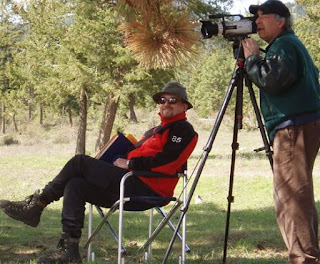
So You Want To Be A Filmmaker

Film can be a very powerful medium, it combines both audio and visual, to tell a story. Watching movies can provide escape as well as excitement, while making a film yourself can be challenging, exciting and magical. Films have the power to affect emotions, they can make you see things from a different perspective, and discover new ideas, or simply create escape or fantasy. Film can make you laugh or cry and each film should have a purpose, whether it is to entertain or inform.

The important thing to remember about making a successful film is simple, it should tell a story.The best way to tell a story is with pictures. Film-making when broken into the components, is visual storytelling, in the shots that make up the scenes, and the scenes put together, make up the complete film.

There are so many different types of film and each serves it purpose.

Studio films are backed by film studios and usually have a hefty budget, averaging $70 million and as high as $300 million. Usually a major star will be featured. On the other end of the spectrum, are the independent films, which are often low-budget, because the money is raised by the filmmaker, without studio financing. Somewhere in between, there are independent divisions of the studio which is really a boutique, operating on smaller budgets but with backing of the studio.

There are advantages and disadvantages to both types. As an independent filmmaker, you have total control, and your film can be created exactly as you envision it, however you have no operating budget. A studio picture, with larger financial backing, and highly paid actors is determined by the studio for the best commercial success and creativity normally takes a back seat.

Your movie can be shot in many different formats. Filmmakers appreciate that the medium on which the story is set can elicit different audience reactions.Multiple choices include analog or digital video or high definition. The choice of film camera can go from super-8 which is an affordable format for beginners to 16mm which produces picture quality that may be adequate for television, or with studio production of 35mm motion picture quality, which is used for most television and feature films.

High definition usher in a new experience, with much sharper pictures, and in some instances it may seem closer to being live.

Great films are seldom made without a good story, and choosing the right material can be more important than anything else.Good ideas for films can come from almost anywhere, once allowed to germinate and blossom, a once nascent idea can develop into a full blown screenplay.

How to Make a Low Budget Movie - Bring Your Screenplay to Life

Feature length movies can be made for ten thousand dollars. However, they are more likely to be turn out better and be a success if you pay about five to ten times as much. There are exceptions of course, and some movies costing only 10 to 20 thousand dollars to make have made millions of dollars. If you want to make a movie on a low budget there are many things to consider besides just getting it made cheaply if you want to be a success. This article explains different ways that movies can be made at low cost, and the pros and cons to the different methods. It is primarily for someone with a screenplay or a movie idea who wants to see their idea come to life.

If you have a movie script or movie idea that you want made into a movie, it can be done, with difficulty, or with relative ease. And it can be completed under budget, or over budget.

To illustrate what I mean, imagine you have a house and you want to add two rooms to it and you have no building experience, but you know what you want. If you have enough money, you can explain what you want to an experienced builder, and have them do it all. If you want to save money, you may think about doing some of the work yourself. You might think, well I have a table saw and I can measure and I can pound nails, so I'll do the framing, and hire someone to finish it. When the finishing crew comes to finish it, they may find the rooms are a bit off square, and not quite level, and for them to finish it it will take lots of extra work because the basics were not done right. The total cost can then be more than if you had hired experts right from the start.

The same applies to making a movie. You have your screenplay, and maybe a camera and some of the equipment, and you know some people who will volunteer, and you have taken some workshops on operating the camera and practiced a bit. You shoot your movie, and then hand it to an editor to finish it. Like with the addition to the house, if the basics were not done right, the editor will have a lot more work to make it presentable, and may in fact not be able to make it totally professional looking because of errors that were made during shooting. It would have been cheaper to get expert help right at the start, and to only concentrate on directing and telling your story.

You might think well, what else can I do? I don't have the money to hire a big professional crew to make it. The answer is to find a very small professional crew, who are expert at shooting low-budget movies to do it. The cost will likely be less than if you tried to "save money" by doing jobs you were not expert at. You can still do a lot of the work yourself, but restrict yourself for the most part to doing the simple no brainer jobs, and let the experts do their thing. You can find filmmakers who have the experience and know how to bring your story to life, and all you have to do is find them. After all, what you really want is a nicely finished, professional looking movie that tells your story. Search, and you will find the people that you need, and be much happier in the long run.